
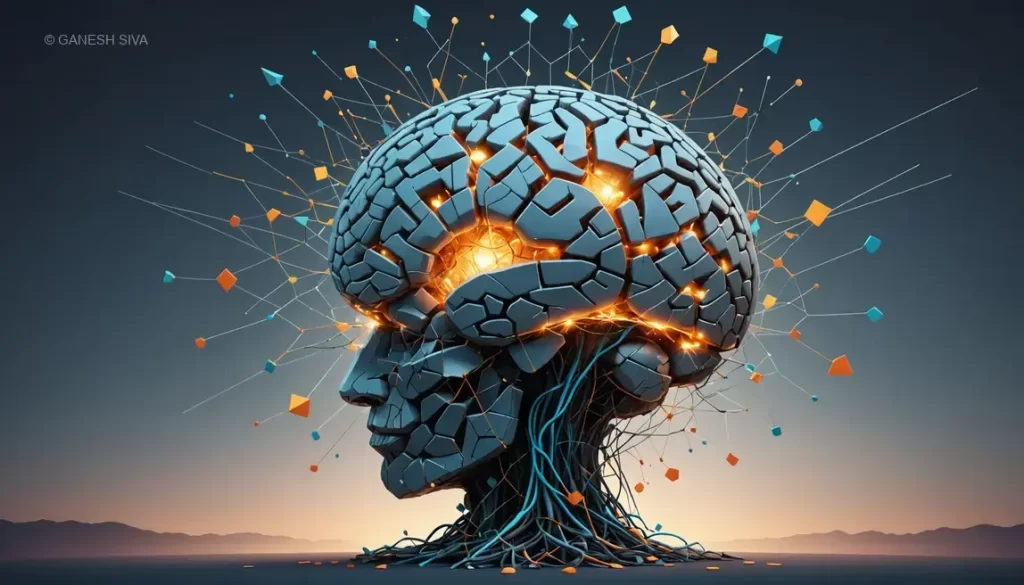
Introduction: The Abstract-Category Effect in Human Cognition
The Abstract-Category Effect shapes how we think and communicate. It involves grouping items based on abstract features. This contrasts with concrete categorization based on physical traits. Abstraction allows us to process complex information efficiently. Our brains use it to navigate a world full of details. This effect influences everything from memory to language. It helps us form mental shortcuts for faster decisions. Understanding it reveals key aspects of human intelligence.
Abstraction is fundamental to cognitive processes. It enables us to see patterns beyond surface-level details. For instance, we categorize ‘justice’ as an abstract concept. Concrete categories might include ‘apple’ or ‘car’. The Abstract-Category Effect enhances our ability to generalize. This leads to more flexible thinking and problem-solving. It underpins creativity and innovation in various fields.
In communication, abstraction allows for nuanced expression. We use abstract terms to discuss ideas and emotions. This effect bridges gaps between different contexts. It helps us convey complex thoughts with simplicity. The Abstract-Category Effect is not just a mental tool. It is a cornerstone of human interaction and understanding.
This deep dive explores its mechanisms and impacts. We will examine cognitive efficiency and neural processes. We will analyze its role in language and thought. By the end, you will grasp its profound influence. Let’s begin with defining the Abstract-Category Effect.
Real-World Scenario: In a business meeting, managers use abstract categories like ‘innovation’ to discuss strategies. This allows them to group diverse ideas under one umbrella. It streamlines decision-making and fosters creative solutions.
Defining the Abstract-Category Effect – Beyond the Basics
The Abstract-Category Effect goes beyond simple grouping. It involves categorizing based on abstract, non-physical attributes. Concrete categorization relies on tangible features like shape or color. Abstraction focuses on functions, relationships, or ideals. This effect boosts cognitive efficiency significantly. Our brains process information faster with abstract categories. They reduce mental load by ignoring irrelevant details.
Abstract categories help in organizing complex knowledge. For example, ‘democracy’ groups various political systems. Concrete categories might list specific countries. The Abstract-Category Effect enhances information processing. It allows for quicker retrieval and application of knowledge. This is crucial in fast-paced environments.
- Abstract categorization uses themes like ‘freedom’ or ‘beauty’.
- Concrete categorization uses items like ‘tree’ or ‘book’.
- Abstraction improves problem-solving by focusing on core principles.
- It aids in learning by connecting disparate concepts.
This effect is evident in everyday life. We use it to make sense of the world. It transforms chaos into manageable mental models. Understanding it reveals how we achieve cognitive mastery.
Real-World Scenario: A teacher uses abstract categories like ‘sustainability’ in a science class. Students group recycling, energy conservation, and biodiversity under this theme. This simplifies learning and encourages critical thinking.
The Cognitive Mechanisms Behind Abstraction
Neural processes enable the Abstract-Category Effect. Pattern recognition is a key mechanism. Our brains identify similarities across different instances. Schema formation organizes these patterns into frameworks. This enhances memory by creating associative networks. Decision-making benefits from these cognitive shortcuts.
Psychological processes include abstraction and generalization. We extract essential features from experiences. This forms abstract categories in our minds. The prefrontal cortex plays a vital role. It integrates information from various brain regions. This supports higher-order thinking and abstraction.
- Pattern recognition helps group abstract concepts like ‘justice’.
- Schema formation builds mental models for efficient recall.
- Neural pathways strengthen with repeated abstraction use.
- These mechanisms improve adaptability in new situations.
Abstraction allows for better memory retention. It links new information to existing categories. Decision-making becomes more informed and swift. The Abstract-Category Effect leverages these mechanisms. They underpin our ability to think abstractly.
Real-World Scenario: A doctor uses pattern recognition to diagnose diseases. Symptoms are grouped into abstract categories like ‘inflammatory response’. This speeds up treatment decisions and improves patient outcomes.
Abstract vs. Concrete Categories in Language and Thought
The Abstract-Category Effect shapes linguistic structures deeply. Abstract terms dominate discussions of ideas and emotions. Concrete language describes physical objects and actions. This effect influences conceptual thinking across contexts. It impacts communication clarity and effectiveness. Problem-solving varies with the type of categories used.
Abstract categories enable nuanced expression in language. We use words like ‘love’ or ‘justice’ to convey complex ideas. Concrete categories are more straightforward, like ‘table’ or ‘run’. The Abstract-Category Effect fosters deeper understanding. It allows for metaphorical and symbolic communication.
- Abstract language includes terms like ‘freedom’ and ‘happiness’.
- Concrete language uses words like ‘car’ or ‘eat’.
- Abstraction aids in solving abstract problems, like ethical dilemmas.
- Concrete thinking is better for practical, hands-on tasks.
This effect bridges different cultural and social contexts. It helps in translating ideas across languages. Thought processes become more flexible with abstraction. The Abstract-Category Effect is key to human innovation.
Real-World Scenario: In a debate, speakers use abstract categories like ‘equality’. This allows them to address broad social issues. Concrete examples are used to illustrate points, enhancing persuasive communication.
The Abstract-Category Effect in Cognitive Processing
The Abstract-Category Effect describes how abstract concepts shape thought. It influences decision-making by grouping ideas into mental categories. This process enhances efficiency but can lead to biases. For example, people often rely on stereotypes when categorizing social groups. Understanding this effect helps improve critical thinking skills. It reveals how our minds simplify complex information. To apply this knowledge, identify abstract categories in daily life. Challenge assumptions by questioning automatic categorizations. Use diverse perspectives to broaden mental frameworks. This reduces cognitive errors and fosters innovation. The effect is crucial in fields like psychology and education. It explains why some learning methods work better than others. By mastering abstract categories, we can optimize mental performance. This leads to more effective problem-solving and creativity.
Practical Applications in Business and Technology
Businesses use the Abstract-Category Effect to improve strategies. It helps in market segmentation by grouping customers into categories. This allows for targeted marketing and product development. Technology leverages it in AI for pattern recognition. Algorithms categorize data to make predictions and decisions. For instance, recommendation systems use abstract categories to suggest content. To implement this, start by analyzing your target audience. Create clear categories based on behaviors and preferences. Use data analytics to refine these groups over time. In tech, design systems that adapt to user categories. This enhances user experience and engagement. Case studies show companies like Amazon thrive with this approach. They categorize products and customers to drive sales. By applying the effect, organizations can streamline operations. It fosters innovation and competitive advantage in fast-paced industries.
Overcoming Limitations and Future Directions
The Abstract-Category Effect has limitations that must be addressed. Over-reliance on categories can cause rigidity and missed opportunities. It may reinforce biases if categories are based on flawed assumptions. To overcome this, promote flexibility in thinking. Encourage continuous learning and adaptation of categories. Use feedback loops to update mental models regularly. In practice, implement training programs that teach critical categorization skills. Foster environments where diverse ideas challenge existing categories. Future research should explore cross-cultural variations in the effect. It could integrate with neuroscience to understand brain mechanisms. Technology may develop dynamic categorization tools. These tools would adjust in real-time to new information. By addressing limitations, we harness the effect’s full potential. This leads to more inclusive and innovative societies. It ensures categories serve as tools, not constraints, for progress.
Conclusion
The Abstract-Category Effect is a fundamental cognitive mechanism that shapes how we perceive and interact with the world. By grouping information into abstract categories, our minds achieve remarkable efficiency, enabling quick decisions and streamlined learning. However, this process is not without pitfalls; it can perpetuate biases and stifle creativity if categories become rigid or based on incomplete data. In business and technology, leveraging this effect has driven innovation, from targeted marketing to advanced AI systems, yet it requires careful management to avoid oversimplification. Looking ahead, overcoming its limitations involves fostering adaptive thinking, integrating diverse perspectives, and developing dynamic tools that evolve with new insights. Ultimately, mastering the Abstract-Category Effect empowers us to use mental frameworks as flexible guides rather than fixed boundaries, enhancing problem-solving and fostering a more nuanced understanding of complexity. By embracing this balance, we can harness its power to drive progress across disciplines, from education to ethics, ensuring that our categorizations enrich rather than limit human potential.