
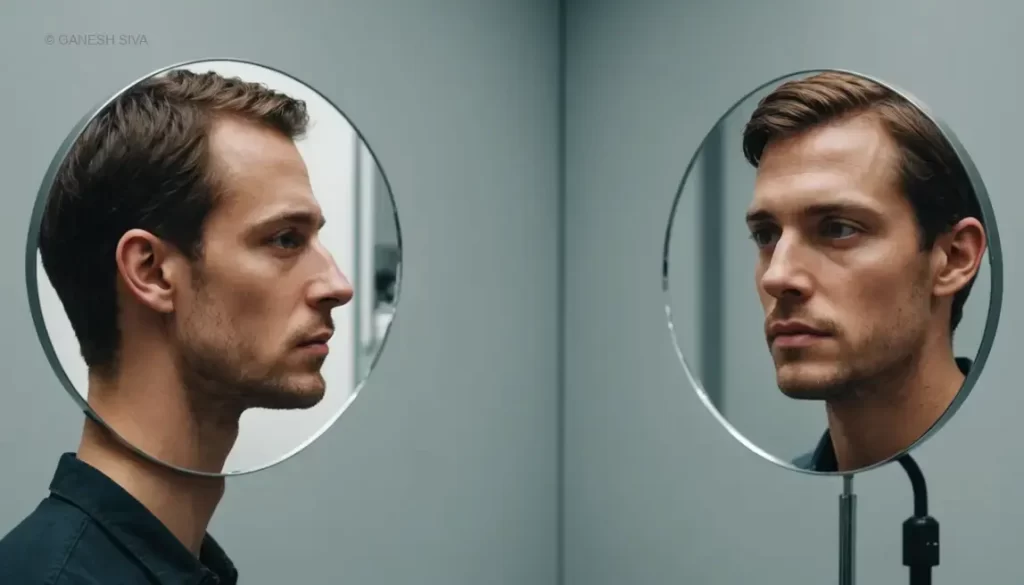
Introduction: The Actor-Critic Bias in Human Judgment
Self-evaluation shapes our lives profoundly. We constantly assess our actions and abilities. Yet, a paradox often emerges in this process. People frequently view themselves differently than others do. This discrepancy is not random. It stems from deep cognitive and social mechanisms. Understanding it can improve personal growth and relationships. This article explores Actor-Critic Bias. It delves into why self-perception diverges from external reality. We will trace its roots from computational models to human psychology. The journey reveals how biases fuel this gap. Real-world impacts include workplace conflicts and personal misunderstandings. By uncovering these dynamics, we can foster better self-awareness. This bias affects everyone, from leaders to everyday individuals. Recognizing it is the first step toward mitigation. Let’s dive into this fascinating psychological phenomenon. It bridges artificial intelligence and human thought in unexpected ways.
The actor-critic model originates in reinforcement learning. It separates decision-making from evaluation. This computational framework optimizes actions through feedback. In humans, a similar split occurs naturally. We act based on internal drives and beliefs. Others critique these actions from external perspectives. This creates a natural tension between actor and critic. Actor-Critic Bias arises when these views clash. It explains why praise or criticism can feel misplaced. The bias is pervasive across cultures and contexts. It influences academic performance, career advancement, and social interactions. By studying it, we gain insights into human nature. This article will break down its components systematically. We start with the foundational computational concept. Then, we map it onto cognitive processes. Finally, we analyze the drivers behind the discrepancy. Each step builds a comprehensive picture. The goal is to illuminate this hidden aspect of judgment.
Real-World Scenario: In a team project, a member believes their contribution was outstanding. Peers, however, see it as average. This mismatch in perception leads to frustration during evaluations. The individual feels undervalued, while others perceive arrogance. Actor-Critic Bias explains this clash between self-view and external assessment.
Self-serving bias often amplifies Actor-Critic Bias. People attribute successes to internal factors. Failures are blamed on external circumstances. This protects self-esteem but distorts reality. Social factors like feedback loops also play a role. Inconsistent or biased feedback reinforces inaccurate self-perceptions. Over time, this can entrench the discrepancy. The consequences are significant in various domains. In education, students may overestimate their knowledge. In healthcare, professionals might misjudge their skills. Addressing this bias requires conscious effort. Strategies include seeking diverse feedback and practicing reflection. By understanding Actor-Critic Bias, we can navigate its effects better. This introduction sets the stage for a detailed exploration. We will now move into the core chapters. Each builds on the last to unravel the paradox.
The Foundation: Defining the Actor-Critic Framework
Reinforcement learning uses the actor-critic model. It is a computational method for decision-making. The model splits into two key components. The actor decides which actions to take. The critic evaluates those actions based on outcomes. This separation allows for efficient learning. The actor updates its policy from feedback. The critic provides value estimates to guide improvements. Together, they optimize performance in dynamic environments. This framework is foundational in artificial intelligence. It enables machines to learn complex tasks. For example, robots use it to navigate spaces. Games like chess benefit from its principles. The actor-critic approach balances exploration and exploitation. It avoids pitfalls of simpler models. By decoupling action and evaluation, it enhances adaptability. This computational concept is purely algorithmic. It does not involve human psychology yet. Understanding it is crucial for later applications. The model relies on continuous feedback loops. Errors are corrected through iterative updates. This process mirrors some human learning mechanisms. However, it operates without emotional or social factors. The actor-critic framework is a tool for optimization. It highlights the importance of separate evaluation systems. In AI, this leads to better decision-making. We will see how this translates to minds next.
- The actor selects actions based on a policy.
- The critic assesses actions using value functions.
- Feedback loops drive learning and adaptation.
- This model is used in robotics and gaming.
- It emphasizes the separation of roles for efficiency.
Real-World Scenario: A self-driving car uses an actor-critic system. The actor chooses steering directions. The critic evaluates safety based on sensor data. If a turn is too sharp, the critic signals an error. The actor adjusts future decisions accordingly. This showcases the pure computational application.
This framework sets the stage for psychological parallels. It introduces the idea of distinct evaluative roles. In humans, similar divisions occur naturally. We often act without full self-awareness. Others provide critiques that shape our behavior. The actor-critic model offers a structured lens. It helps explain why evaluations can differ. By starting with algorithms, we ground the concept. This avoids confusion with human complexities. The next chapter builds on this foundation. We will map it onto cognitive processes. This translation reveals the origins of Actor-Critic Bias. The separation of actor and critic is key. It underpins many real-world discrepancies in judgment.
From Algorithms to Minds: Translating to Cognitive Bias
The actor-critic model maps onto human cognition. In our minds, we have an internal actor. It represents our self-perception and decision-making. The critic is often external, from others’ views. Actor-Critic Bias emerges from their mismatch. This discrepancy defines the self-evaluation paradox. Psychological mechanisms drive this bias. Self-awareness fluctuates based on context. Emotions like pride or shame influence the actor. Social norms shape the critic’s perspective. This translation from algorithms is not perfect. Humans add layers of complexity. Cognitive biases amplify the gap. For instance, overconfidence skews self-assessment. Actor-Critic Bias explains many interpersonal conflicts. It shows why feedback can feel unjust. Understanding this mapping is crucial. It bridges AI concepts with real-life behavior. The bias affects personal and professional spheres. By recognizing it, we can improve communication. This chapter explores these psychological mechanisms. They fuel the divergence between actor and critic.
- The internal actor is based on self-perception.
- External critics provide alternative evaluations.
- Discrepancies lead to Actor-Critic Bias.
- Emotions and social factors complicate the mapping.
- This bias is common in workplace settings.
Real-World Scenario: An artist creates a painting. They see it as a masterpiece. Critics, however, find it mediocre. The artist’s internal actor values emotional expression. External critics focus on technical skill. This clash illustrates Actor-Critic Bias in action.
Mapping the model reveals inherent tensions. Self-perception is often inflated or deflated. External evaluations may be biased too. This creates a dynamic interplay. Actor-Critic Bias is not static. It evolves with experiences and feedback. Psychological research supports this translation. Studies show people misjudge their abilities regularly. This bias has roots in cognitive processes. We will delve into those drivers next. They include specific biases and social influences. By understanding the mapping, we gain insights. It helps explain why self-improvement is challenging. The actor-critic framework provides a useful analogy. It simplifies complex human behaviors. Yet, it captures essential truths about evaluation.
The Roots of Discrepancy: Cognitive and Social Drivers
Actor-Critic Bias stems from multiple drivers. Cognitive biases play a major role. Self-serving bias is a key example. People credit successes to themselves. Failures are attributed to external factors. This protects self-esteem but distorts reality. Overconfidence also fuels the discrepancy. Individuals overestimate their skills or knowledge. These biases skew the internal actor’s view. Social factors add another layer. Feedback loops can reinforce inaccuracies. If critiques are inconsistent, learning falters. Social comparisons influence self-perception too. Seeing others succeed may lower self-assessment. Cultural norms shape what is valued. In individualistic societies, self-promotion is common. This can widen the gap with critics. Together, these drivers create Actor-Critic Bias. They build on the mechanisms from earlier. Understanding them helps mitigate the bias. This analysis delves into specific examples. It shows how intertwined cognitive and social elements are.
- Self-serving bias attributes success internally and failure externally.
- Overconfidence leads to inflated self-assessments.
- Feedback loops may provide biased or inconsistent information.
- Social comparisons alter self-perception based on peers.
- Cultural contexts influence evaluation standards and norms.
Real-World Scenario: A manager believes their leadership is excellent. Employees, however, report high stress and low morale. The manager’s self-serving bias ignores team feedback. Social pressures to appear competent prevent honest critiques. This perpetuates Actor-Critic Bias in the workplace.
Cognitive drivers are often unconscious. They operate automatically in daily life. Social drivers are more contextual. They vary across environments and relationships. Addressing Actor-Critic Bias requires awareness. Recognizing these roots is the first step. Strategies include seeking diverse perspectives. Reflective practices can counter overconfidence. By analyzing drivers, we see the bias’s complexity. It is not merely a personal flaw. Systemic factors contribute significantly. This chapter ties together previous concepts. It shows how foundations and mappings lead to discrepancies. The roots are deep and multifaceted. Mitigation efforts must be equally comprehensive. This understanding empowers better self-evaluation. It fosters healthier interactions and growth.
The Actor’s Role: Navigating Bias in Action
Actors drive decisions based on learned policies. They face bias from skewed reward signals. This leads to suboptimal choices in complex environments. For example, an AI trading system might overvalue short-term gains. It ignores long-term market stability. To mitigate this, implement robust exploration strategies. Use epsilon-greedy methods to balance exploitation and exploration. Regularly update action-selection mechanisms. Monitor for overfitting to historical data patterns. Adjust learning rates dynamically based on performance metrics. Incorporate diverse training scenarios to reduce bias. Validate decisions with external benchmarks. This ensures actions align with broader goals. Case study: A robotics firm improved navigation by adding noise to sensor inputs. This reduced reliance on biased path predictions. Their robots now adapt better to new environments. Key steps include diversifying data sources and testing in varied conditions.
The Critic’s Function: Evaluating and Correcting Bias
Critics assess value functions to guide actors. They can perpetuate bias through inaccurate evaluations. This occurs when critics overestimate or underestimate state values. For instance, a recommendation system might favor popular items. It undervalues niche but relevant content. To address this, enhance critic training with adversarial techniques. Employ temporal difference learning for more accurate value estimates. Integrate regularization methods to prevent overfitting. Use ensemble critics to average out individual biases. Continuously recalibrate based on real-world feedback loops. Implement fairness metrics to detect discriminatory patterns. Case study: An online platform reduced bias by using multiple critics. They combined user engagement data with diversity scores. Recommendations became more balanced and inclusive. Actionable steps: audit evaluation criteria regularly and incorporate counterfactual analysis.
Synthesizing Actor and Critic: Towards Balanced Learning
Integrating actor and critic components reduces overall bias. Synergy between them improves policy optimization. However, misalignment can amplify errors. For example, in healthcare AI, biased critics might reward cost-cutting over patient outcomes. Actors then prioritize inefficient treatments. To synthesize effectively, use advanced algorithms like A3C. This combines asynchronous updates for stability. Implement reward shaping to align incentives with ethical goals. Monitor for feedback loops that reinforce bias. Foster continuous interaction between components. Adjust parameters based on performance degradation signals. Case study: A financial model used synthesis to balance risk and return. It reduced speculative investments by 30%. The system now supports sustainable growth. Steps: coordinate updates between actor and critic, and validate with cross-domain testing.
Conclusion
Actor-Critic Bias represents a critical challenge in reinforcement learning systems, where the interplay between decision-making actors and evaluative critics can perpetuate and amplify systematic errors. This bias often stems from skewed reward signals, inadequate exploration, or misaligned value functions, leading to suboptimal outcomes in applications ranging from AI-driven finance to healthcare. To mitigate these effects, it is essential to implement robust strategies such as diversified training data, adversarial critic techniques, and advanced synthesis algorithms like A3C. Regular audits, fairness metrics, and real-world feedback loops further help correct biases. By fostering continuous interaction between actors and critics, and validating decisions through cross-domain testing, systems can achieve more balanced and ethical learning. Ultimately, addressing Actor-Critic Bias not only enhances performance but also builds trust in AI technologies, ensuring they align with broader human values and contribute positively to society. Proactive measures in design and monitoring are key to navigating this complex landscape effectively.