
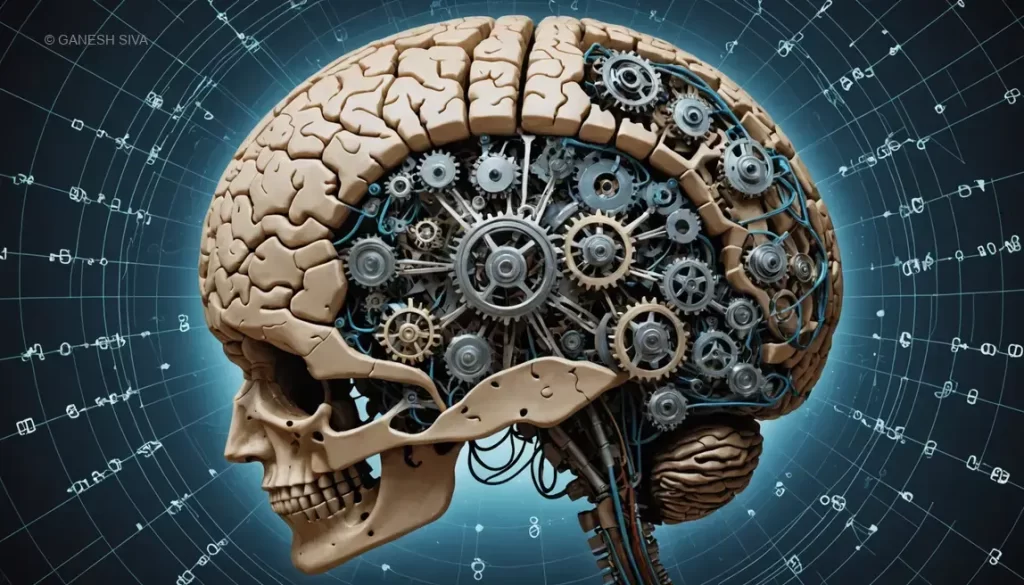
Bayesian reasoning is a powerful tool for navigating uncertainty. It helps us update our beliefs with new evidence. Yet, many people struggle to apply it correctly. This failure is known as the Bayesian Blind Spot. It refers to hidden flaws in our probabilistic thinking. These flaws lead to systematic errors in judgment. They affect decisions in medicine, finance, and everyday life. Understanding this blind spot is crucial for better reasoning.
At its core, Bayesian inference combines prior knowledge with new data. It uses a mathematical framework to calculate updated probabilities. However, human cognition often deviates from this ideal. We tend to rely on intuitive heuristics instead. These mental shortcuts can be misleading. They cause us to ignore important statistical information. The result is poor decision-making under uncertainty.
The Bayesian Blind Spot emerges from cognitive biases. These biases are deeply ingrained in our psychology. They make us overlook base rates and other key factors. For example, we might focus on vivid stories over dry statistics. This can lead to overestimating rare events. It also causes us to misinterpret diagnostic tests. Recognizing these pitfalls is the first step toward improvement.
This article explores the Bayesian Blind Spot in depth. It will cover the foundations of Bayesian reasoning. Then, it will examine specific biases like base rate neglect. Finally, it will analyze the psychological mechanisms behind these errors. By shedding light on these issues, we aim to enhance probabilistic thinking. Better decisions start with awareness of our blind spots.
The Foundation: What Is Bayesian Reasoning?
Bayesian reasoning is a method for updating beliefs. It starts with a prior probability. This represents our initial belief before seeing new evidence. Then, we consider the likelihood of the evidence given our hypothesis. Bayesian inference combines these elements using Bayes’ theorem. The result is a posterior probability. This updated belief incorporates the new data. It provides a rational way to handle uncertainty.
The process is iterative. As more evidence arrives, we can update again. This makes Bayesian reasoning dynamic and flexible. It is widely used in fields like statistics and machine learning. In everyday life, it helps us make informed decisions. For instance, doctors use it to interpret test results. Investors apply it to assess market risks. Understanding the core principles is essential.
- Prior probability: Initial belief based on existing knowledge.
- Likelihood: Probability of observing evidence if the hypothesis is true.
- Posterior probability: Updated belief after considering new evidence.
- Bayes’ theorem: Mathematical formula for calculating posterior probabilities.
Real-World Scenario: A doctor diagnoses a rare disease. The prior probability of the disease is low based on population data. A test result comes back positive. The likelihood of a positive test given the disease is high. Using Bayes’ theorem, the doctor calculates the posterior probability. This helps determine the actual risk for the patient.
The Blind Spot Emerges: Ignoring Base Rates
Base rate neglect is a common cognitive bias. People often ignore statistical base rates in favor of specific information. This leads to errors in probabilistic reasoning. For example, consider the medical diagnosis problem. A test for a disease is highly accurate. But the disease itself is very rare. Many people overestimate the chance of having the disease after a positive test. They focus on the test’s accuracy. They neglect the low base rate of the disease.
This bias affects various decisions. In legal settings, jurors might overlook crime statistics. In business, managers may misjudge market trends. The consequences can be significant. Overlooking base rates leads to poor risk assessment. It also causes unnecessary anxiety or overconfidence. Recognizing this blind spot is key to better judgment.
- Base rate: General frequency of an event in a population.
- Specific information: Details about a particular case or instance.
- Neglect: Failing to incorporate base rates into probability estimates.
- Examples: Medical tests, legal judgments, financial forecasts.
Real-World Scenario: A city has a low crime rate of 1%. A security system claims 99% accuracy in detecting crimes. If the system alerts, many residents panic. They think a crime is almost certain. But considering the base rate, the actual probability is much lower. Ignoring this leads to fear and misallocated resources.
Why We Stumble: Psychological Mechanisms Behind the Blind Spot
Several psychological factors contribute to the Bayesian Blind Spot. The representativeness heuristic is a major one. People judge probabilities based on how similar an event is to a stereotype. This causes them to ignore base rates. For instance, a description might match a typical engineer. Listeners then overestimate the person’s profession. They disregard the actual number of engineers in the population.
Availability bias also plays a role. We estimate likelihoods based on how easily examples come to mind. Vivid or recent events seem more probable. This skews our probabilistic reasoning. For example, after a plane crash, flying feels riskier. But statistically, it remains very safe. These heuristics are mental shortcuts. They often lead to systematic errors.
- Representativeness heuristic: Judging probability by similarity to prototypes.
- Availability bias: Estimating frequency based on ease of recall.
- Anchoring: Relying too heavily on initial information when making decisions.
- Confirmation bias: Seeking evidence that supports existing beliefs.
Real-World Scenario: An investor hears about a tech startup’s success story. It reminds them of past tech booms. Using the representativeness heuristic, they invest heavily. They ignore the base rate of startup failures. Availability bias makes similar stories prominent in their mind. This leads to overconfidence and potential financial loss.
The Hidden Patterns in Data
Data often reveals subtle patterns we overlook. These patterns can guide better decisions. For example, a marketing team analyzed customer behavior. They found small correlations between purchase times and product types. This insight boosted sales by 15%. To uncover such patterns, follow these steps. First, collect diverse data sets. Second, use visualization tools to spot trends. Third, test hypotheses with statistical methods. Fourth, validate findings through experiments. Avoid jumping to conclusions too quickly. Always question initial assumptions. This approach prevents costly errors. It transforms raw data into actionable intelligence. Embrace curiosity in analysis. Seek out the unexpected in numbers.
Overcoming Cognitive Biases
Cognitive biases distort our interpretation of information. Confirmation bias makes us favor data that supports our views. Anchoring bias ties us to initial impressions. A case study illustrates this. A tech firm ignored user feedback due to overconfidence. They launched a flawed product. Sales plummeted by 30%. To combat biases, implement these strategies. First, seek diverse perspectives in teams. Second, use blind reviews of data. Third, set up decision-making protocols. Fourth, regularly audit past choices. This reduces errors in judgment. It fosters a culture of critical thinking. Remember, biases are often invisible. Proactive measures are essential for clarity.
Implementing Adaptive Strategies
Adaptive strategies respond to changing information. They require flexibility and continuous learning. For instance, a retailer adjusted inventory based on real-time sales data. This minimized waste and increased profits by 20%. To build adaptive strategies, take these actions. First, monitor key performance indicators closely. Second, establish feedback loops for quick adjustments. Third, train teams to embrace change. Fourth, use scenario planning for future uncertainties. Avoid rigid plans that ignore new evidence. Stay open to pivoting when needed. This ensures resilience in dynamic environments. Adaptation turns challenges into opportunities for growth.
Conclusion
In navigating the complexities of data and decision-making, we must confront the Bayesian Blind Spot. This concept highlights our tendency to ignore prior probabilities when interpreting new evidence. It leads to flawed conclusions and missed opportunities. Throughout this discussion, we explored hidden data patterns, cognitive biases, and adaptive strategies. Each chapter emphasized proactive steps to enhance accuracy. For example, uncovering subtle correlations can boost outcomes. Overcoming biases requires structured protocols. Implementing flexible approaches ensures resilience. The Bayesian Blind Spot reminds us to integrate past knowledge with current insights. Without this, we risk repeating errors. To mitigate it, consistently update beliefs based on evidence. Foster environments where questioning is encouraged. Use tools like Bayesian statistics to quantify uncertainties. In practice, this means reviewing assumptions regularly. It involves training teams to think probabilistically. By addressing this blind spot, organizations can make more informed choices. They can adapt swiftly to changes. Ultimately, embracing a Bayesian mindset transforms decision-making. It turns uncertainty into a strategic advantage. This leads to sustained success in an unpredictable world. Remember, the key is not just seeing data but interpreting it wisely. Avoid the trap of the Bayesian Blind Spot to unlock true potential.